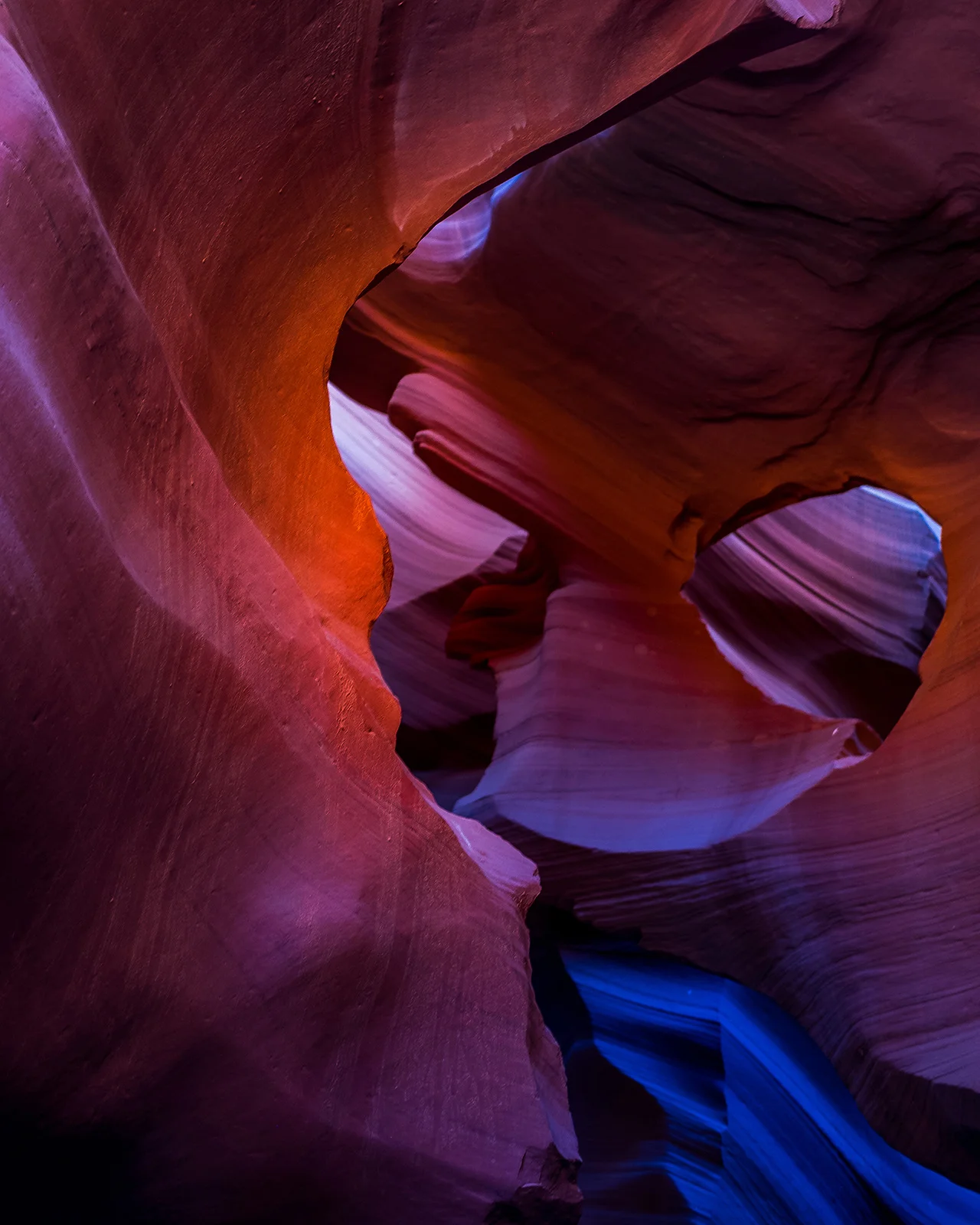
Lower Antelope Canyon, Navajo Nation land outside Page, Arizona.
I shot this handheld, on the cheap tour, in a group of ten. At the time there were two options — a walking tour at about thirty dollars a head, and a photographer's tour at something like two hundred and twenty. We took the thirty. That upper tier no longer exists, which means the tour I was on is now the only tour there is.
- Guide
- Mandatory. Navajo Nation Parks and Recreation requires a guide at every Antelope Canyon location — there is no self-guided option and never has been.
- Permit
- A Navajo Nation permit is required and is normally bundled into the tour price.
- Tripods
- Banned on all general tours, along with monopods and selfie sticks.
- Photo tours
- Gone. No operator is currently running tripod-permitted photographer tours, and Navajo Parks has not been issuing photography permits. The standard walking tour is the only option.
- Reality
- Handheld, in a group of eight to thirteen, roughly 30–45 minutes inside.
- Settings
- My guide suggested ISO 800. Online guides often say 100–400, but that is tripod-era advice and no longer applies.
- Shutter
- 1/60s if you shoot genuinely steady, 1/120s if not. Set that first and let ISO go wherever it must.
- Therefore
- Fast lens, and every decision made before you walk in.
- Good news
- I got my frames on the cheap tour. You do not need to have bought the expensive one.
The cheap tour is now the only tour
When I went there were two tiers. The standard walking tour was around thirty dollars. The photographer's walking tour was something like two hundred and twenty — fewer people, longer inside, tripod allowed, a guide managing the crowd for you. That upper tier is what produced most of the famous images of this canyon.
We took the thirty-dollar one.
Since then the photographer's tours have gone. No operator is currently running the tripod-permitted version, and Navajo Parks has not been issuing photography permits. Tripods and monopods are banned on the general tours, along with selfie sticks. What you can book today is exactly what I booked: a group of eight to thirteen, thirty to forty-five minutes inside, handheld.
Which is the encouraging part. Everything on this page was learned on the tour you are going to be on. You are not reading advice from someone who bought access you cannot buy.
It does mean the technique is different from every tutorial written before 2020. There is no time to bracket, no time to wait for the light to move, no time to change lenses. Whatever is on the camera when you walk in is what you are shooting with.
Thirty seconds of clear frame
Here is what actually happened, and it is the reason I came away with anything.
My companion and I were the only two people on the tour carrying serious cameras. The guide noticed, and was sympathetic about it. At each section of the canyon she let the two of us in first and gave us roughly thirty seconds before the other eight guests filed in behind us. Thirty seconds of empty canyon, repeated through the tour, is an enormous amount when the alternative is shooting over shoulders.
The other guests were entirely fine with it. Everyone was cool and supportive about the whole thing.
She also offered some rudimentary settings advice unprompted — ISO 800 for shooting inside the canyon.
That is worth dwelling on, because plenty of online guides will tell you ISO 100 to 400 instead, and they are not wrong so much as out of date. Those numbers assume a tripod. They come from the era of the photographer's tours, when you could plant three legs on the sand and take a long exposure at base ISO. You cannot do that now.
Handheld, the number that actually governs everything is shutter speed. Work backwards from it: if you shoot genuinely steady — elbows in, breath held, a beat between frames — you can hold about 1/60s. If you know you are not that person, give yourself 1/120s. Pick whichever is honest, open the aperture, and let the ISO land wherever it has to in order to hold that shutter. A grainy sharp frame is a photograph. A clean blurred one is nothing.
Set all of it in the car park. You will not be standing in there doing arithmetic.
I want to be careful how I put this, because it was a kindness, not a policy. You cannot book it, you should not ask for it, and you certainly should not turn up expecting it. What you can do is carry an obvious real camera, be pleasant, be quick, and never make yourself the reason the group is running late. If a guide chooses to give you a gap, take it gratefully and get out of the way on time. This is their canyon and their livelihood, and the goodwill that got me those thirty seconds is the same goodwill you would be spending.
You pay to be there at all
Lower Antelope Canyon is on Navajo land outside Page, Arizona. You go with a guide, and you pay a permit to be there at all. Both of those are non-negotiable and both are the point — this is not a national park with an entrance booth, it is a nation's land with its own rules.
The waiting is the trip
I had hours to kill waiting on the light, so I sat in the only dive bar in town, full of Navajo men, six dollars a pitcher. Someone rang the nautical bell at the end of the bar and the barkeep set a fresh pint in front of me.
Who bought this? Joe, down at the end. I sent a pitcher back his way, and the bell rang again. I asked whether I might try something different this time.
"Tradition is whatever's in front of you."
Another red ale arrived. Then the light came.
I include that because the scheduling reality of this place is that you will have dead hours, and how you spend them is part of the trip. Page is a small town built around a dam and a lake. Sit in it for an afternoon rather than driving somewhere.
What the stone actually looks like
The walls ripple in waves of amber and rust, carved by millennia of floodwater through Navajo sandstone. Up close the stone loses its identity as rock — it looks muscular, fluid, almost alive, more like skin or bone than geology. Ten million years of patience shaped into something that should not be possible.
Worth knowing for composition: the pictures people remember from here are rarely the wide ones. The canyon does not photograph well as a place. It photographs well as a surface.
Do not count on light beams
I cannot tell you which month I was there — it was years ago and I did not write it down. So take this section as general orientation rather than my personal advice, and check it against your operator before you book.
What I can tell you is what I did not see. Plenty of people book Lower Antelope expecting the famous vertical columns of light. I saw none, and was not aware of any while I was in there. Whether that comes down to the canyon's geometry, the season I happened to visit, or simply the hour of my tour, I genuinely do not know — accounts differ, and beam visibility may well be seasonal.
So if beams are the reason you are going, ask the operator directly which canyon and which dates actually deliver them. Do not infer it from photographs, including mine.
What Lower gives you regardless is arguably better for a print anyway: reflected, ambient light bouncing between the walls, which is what turns the sandstone those saturated ambers and rusts. It is a glow rather than a spotlight, and it is what the canyon is really for once you strip away the posters.
On timing, the general consensus runs roughly like this: early afternoon, somewhere around 1pm to 3pm, gets the warmest light reaching deepest into the slot, while morning tours tend to be less crowded. Spring and autumn get recommended less for the light than for the weather — spring sits ahead of the monsoon, autumn behind it — and for thinner crowds.
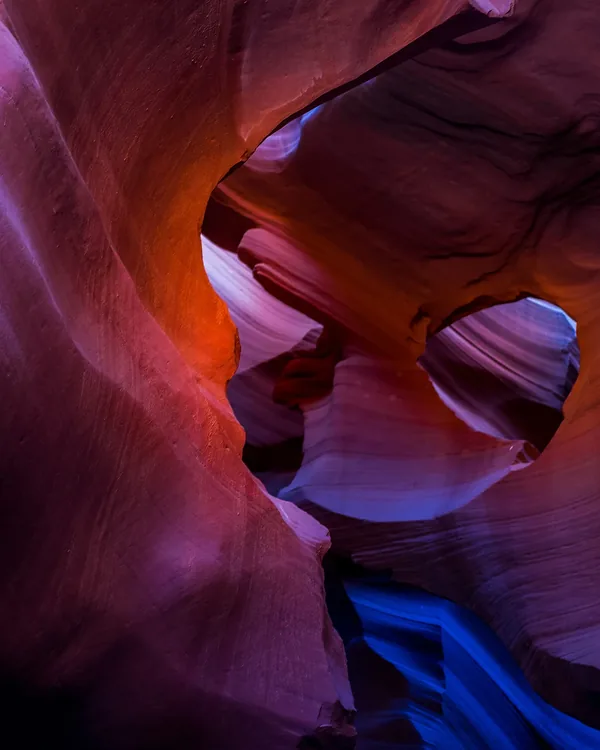
Rainbow Colors, Antelope Canyon
On fine art paper, metal, or canvas. From $50, free US shipping. See also Lady in the Wind, from the same canyon.
See the print →The tour prices above are what I paid on the day, some years ago, and are not current pricing. Tour rules, permits and equipment policies are set by Navajo Nation Parks and Recreation and change without much notice. Confirm everything directly with your operator before booking. Last checked August 2026.